
Module 3 is the longest part of the dossier, the hardest part to fake, and the part where a junior reviewer forms an opinion of the applicant inside the first twenty pages. A regulatory affairs manager picking up a dossier to file into Saudi Arabia, Nigeria or the UK needs to know which sub-sections the assessor actually opens first, what they look for that the ICH guideline does not spell out, and where the predictable failures sit.
The sub-section map, 3.2.S and 3.2.P.
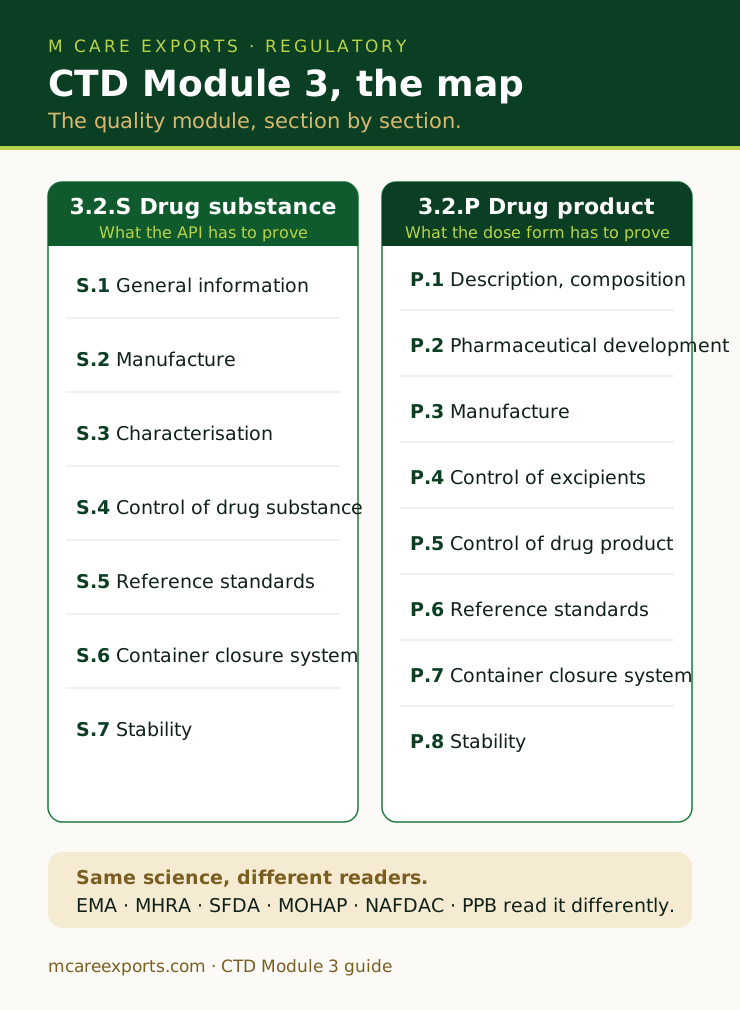
Module 3 sits inside the five-module ICH Common Technical Document structure. Module 1 is regional administrative. Module 2 carries the summaries, Quality Overall Summary, Non-clinical Overview, Clinical Overview. Module 3 is Quality. Modules 4 and 5 are the non-clinical and clinical study reports.
Inside Module 3, the skeleton is fixed:
- 3.1 Table of contents.
- 3.2 Body of data.
- 3.2.S Drug substance, one full set per active ingredient. Sub-sections S.1 General information, S.2 Manufacture, S.3 Characterisation, S.4 Control of drug substance, S.5 Reference standards, S.6 Container closure, S.7 Stability.
- 3.2.P Drug product. Sub-sections P.1 Description and composition, P.2 Pharmaceutical development, P.3 Manufacture, P.4 Control of excipients, P.5 Control of drug product, P.6 Reference standards, P.7 Container closure, P.8 Stability.
- 3.2.A Appendices, facilities, adventitious agents, novel excipients.
- 3.2.R Regional information, stability zone data, batch execution records, approved labelling proofs as the receiving regulator asks.
- 3.3 Literature references.
A reviewer knows that map by heart. If the table of contents at 3.1 is out of order, the hyperlinks resolve to the wrong PDFs, or 3.2.R is empty where the regulator expects a Zone IVb supplement, the reviewer draws a conclusion about the rest of the pack before they have opened it.
Drug substance, what 3.2.S has to prove.
The substance section exists to answer four questions: who makes the active, how it is made, what is in it that should not be, and how stable it is. Every sub-section maps to one of those.
S.1 General information
Nomenclature (INN, CAS, chemical name), structure and stereochemistry, physicochemical properties. Short section, but reviewers read it for consistency with what the pharmacopoeia monograph says. A solubility statement that contradicts the USP or Ph. Eur. monograph triggers a query before the assessor has turned the page.
S.2 Manufacture
Five sub-parts and every one is read. S.2.1 names the manufacturer, full address, manufacturing licence number. S.2.2 is the process description and flow diagram. S.2.3 is the controls of materials, this is where the starting-material justification lives, and it is one of the commonest places for a dossier to get bounced. The regulator wants to see a defensible choice of starting material, not a stage picked to shorten the process description. S.2.4 is the controls of critical steps and intermediates. S.2.5 is process validation and evaluation.
S.3 Characterisation
S.3.1 elucidation of structure. S.3.2 impurities, this is the section regulators queue up on. The applicant lists every identified organic impurity, every potential degradant, every residual solvent (against ICH Q3C Class 1-3 limits), and the elemental impurity risk assessment against ICH Q3D. If the dossier was written before Q3D became an active expectation, the elemental impurity assessment is almost always where the first deficiency letter lands.
S.4 Control of drug substance
Specification, analytical procedures, validation data, batch analyses of at least three consecutive commercial-scale batches, and the justification for every specification limit. Reviewers challenge specification limits that are wider than the batch data supports, the "we set it at the monograph limit because the monograph allows it" argument does not usually survive.
S.5 Reference standards or materials
The reference standards used for assay and impurities. Primary standards against a pharmacopoeia reference; secondary standards qualified against primaries, with the qualification certificates appended.
S.6 Container closure system
Drum, liner, desiccant. Specification and compatibility data.
S.7 Stability
Summary and conclusions, the stability commitment (an explicit undertaking to continue long-term stability and report out-of-specification results), and the actual stability data tables. The commitment is where EMA and MHRA reviewers focus, a vague commitment is treated as no commitment.
Drug product, what 3.2.P has to prove.
If 3.2.S answers "who made the active and what is it," 3.2.P answers "how is the finished dosage form built and how does it behave." Eight sub-sections, every one consequential.
P.1 Description and composition
Unit formula, role of each excipient, overages if any. A reviewer cross-checks this against P.5 specification and against the label claim. A mismatch of even 1 mg in a declared excipient will earn a query.
P.2 Pharmaceutical development
The science-based narrative. Why this formulation, why these excipients, why this manufacturing route, how the critical quality attributes were identified, what the control strategy is. P.2 is the section where the coherence of the whole dossier is tested, the risk assessments here should drive the specifications in P.5 and the stability protocol in P.8. If P.2 reads like a generic template with no molecule-specific reasoning, the reviewer treats the rest of the dossier with suspicion.
P.3 Manufacture
Manufacturer name and licence, batch formula, process description and process controls, controls of critical steps and intermediates, process validation and evaluation. For solid oral generics, P.3.5 process validation is where the regulator looks for evidence the process delivers the target profile at commercial scale, not only at pilot scale.
P.4 Control of excipients
Specifications for every excipient, analytical procedures, validation, source of non-compendial excipients, adventitious agents safety evaluation where relevant. Reviewers chase excipients that are compendial in the country of manufacture but not in the country of filing.
P.5 Control of drug product
Specification, analytical procedures, validation, batch analyses, characterisation of impurities, justification of specifications. Dissolution method and limits sit here, and dissolution is where generic bioequivalence dossiers commonly trip, an undiscriminating method that fails to differentiate test from reference is a predictable deficiency.
P.6 Reference standards or materials
As per S.5, for the finished product where applicable.
P.7 Container closure system
Primary and secondary packaging specification, compatibility and suitability data. For blister-packed tablets going into Zone IVb markets, moisture ingress studies matter more than in Zone II dossiers.
P.8 Stability
Summary, stability commitment, stability data tables, post-approval stability protocol. The stability package must match the climatic zone of the filing market, Zone II for temperate Europe, Zone IVb for the GCC and most of sub-Saharan Africa. Submitting Zone II data to a Zone IVb market is the single most predictable way to have a dossier refused.
How EMA, MHRA, SFDA, MOHAP, NAFDAC and PPB read it differently.
The CTD is harmonised. The review culture around it is not. The same Module 3 sent to six regulators will come back with six different deficiency letters, each drawing on the reviewer's national priorities.
EMA, data-heavy, science-first
EMA assessors are the most likely to query the impurity qualification strategy, especially mutagenic and potentially mutagenic impurities under ICH M7. The "science, not paperwork" principle is most visible here: a P.2 Pharmaceutical Development section that reads as a template dump will trigger a major objection at the Day-120 list. Genotoxic impurity risk assessments are rarely deep enough on first filing.
MHRA, post-Brexit, coherence-focused
MHRA runs its own review against the same CTD structure. Where the product has an EU MA, the MHRA reviewer cross-checks coherence between the EU Module 1 and the UK Module 1, and between the dossier's GMP claims and the site's EU-GMP inspection history. The MHRA Specials and the licensed-route dossiers have noticeably different documentation footprints.
SFDA, Saudi Arabia, Zone IVb-rigorous
SFDA assessors focus hard on Zone IVb stability data (30°C / 75% RH long-term, 6 months accelerated at 40°C / 75% RH). They expect the API Drug Master File to be lodged with the SFDA API section separately, an applicant who refers to "API supplier X" without the supplier having a DMF on file will be asked for it. Impurity profile adequacy for Saudi-sold batches is a recurring challenge point.
MOHAP and the GCC Centralised route
UAE MOHAP (and the GCC Centralised Procedure that links it to SFDA, Kuwait, Oman, Qatar, Bahrain) layers Arabic labelling and artwork rendering, the GCC Unified Pricing file, and an Arabic translation of the Quality Overall Summary. A poor Arabic QOS will get the dossier bounced at administrative validation, before a technical assessor has opened Module 3.
NAFDAC, Nigerian storage conditions
NAFDAC reviewers focus on physical characterisation and stability under Nigerian storage, hot, humid, often with interrupted cold chain. Dissolution method validation for bioequivalence purposes is a recurring deficiency. NAFDAC occasionally requests a supplementary local stability study against Nigerian climate data, on top of the Zone IVb pack.
PPB, TMDA, NDA, East African Community joint assessments
Kenya PPB, Tanzania TMDA, Uganda NDA and the EAC joint assessment procedure concentrate on API source justification, Zone IVb stability, and bioequivalence evidence where the product is an ARV or TB-line medicine. WHO-PQ approval is frequently accepted as surrogate evidence for the bioequivalence element.
The six recurring defects in first-time dossiers.
Across EMA Day-120 letters, MHRA RFIs, SFDA deficiency letters and NAFDAC queries, the same six problems recur. A regulatory desk that has filed fifty Module 3 packs has a checklist for each of them.
- Stability data in the wrong zone. Submitting Zone II temperate data (25°C / 60% RH) into a Zone IVb market (GCC, sub-Saharan Africa, South-East Asia). The reviewer sends the whole P.8 section back for re-doing. Fix: plan the stability programme against the market list on day one, not against the country of manufacture.
- API DMF not cross-referenced. The dossier names "API supplier X" but the supplier has not lodged their DMF with the receiving authority. The reviewer cannot read the closed part, cannot assess the synthesis, and queries. Fix: confirm the DMF is on file with the receiving authority before submission, and cite the reference number in S.2.1.
- Impurity qualification thresholds wrong for dose. ICH Q3A reporting, identification and qualification thresholds depend on maximum daily dose. A dossier that uses default limits without re-calculating for its specific dose invites an immediate query on S.3.2 and S.4.1.
- Dissolution profile only on Zone I/II conditions. For generic bioequivalence, dissolution in multiple media (pH 1.2, 4.5, 6.8 and water) is table-stakes, but for Zone IVb filings a stability-indicating dissolution at accelerated storage is also expected. Missing that pack is a predictable NAFDAC or SFDA query.
- Missing ICH Q3D elemental impurity risk assessment. Q3D is now expected across all active regulators, including for legacy products with marketing authorisations pre-dating its entry into force. A dossier without a Q3D risk assessment on S.3.2 and P.5 is incomplete on its face.
- QOS that is a verbatim copy of Module 3 sections. The Quality Overall Summary is supposed to be the critical analysis, the reviewer's guide to the dossier. A QOS that reads as a 50-page cut-and-paste of 3.2 signals the dossier has never been independently reviewed, and invites the assessor to scrutinise the whole pack twice as hard.
Complete vs compliant, coherence across sections.
A complete Module 3 has every sub-section filled. A compliant Module 3 has every sub-section coherent with every other sub-section. The difference is what reviewers look for that the ICH guideline does not explicitly spell out.
Three coherence checks appear in almost every deficiency letter:
- P.2 risk assessment drives P.5 specification. If P.2 Pharmaceutical Development identifies an impurity as a critical quality attribute, P.5 specification must control it. If it does not, the reviewer asks why. Conversely, if P.5 controls something that P.2 does not rationalise, the specification is treated as unjustified.
- P.5 specification drives P.8 stability protocol. The attributes monitored in stability must include every attribute in the release specification that could drift on storage, assay, related substances, dissolution, moisture, microbial limits where relevant. A stability protocol narrower than the specification is flagged.
- S.2.3 starting-material justification connects to the whole chain. The starting-material choice in S.2.3 implies which impurities are process-related and controlled upstream, and which must be controlled in S.4.1 specification. An applicant who picks a late starting material to compress the process description ends up with an impurity profile the reviewer cannot trace, and that is the fastest route to a major objection.
The stability commitment in S.7 and P.8 is the other place coherence is tested. It has to be concrete, which batches will be placed on long-term stability, how often they will be tested, how out-of-specification results will be reported to the authority. Vague commitments are the sort of thing that survive a junior reviewer and collapse at the Committee for Medicinal Products for Human Use (CHMP) or SFDA review board stage.
M Care's Mumbai regulatory desk authors CTD Module 3 for multiple markets from a single master pack, re-using the scientific base and tailoring the regional annexes. We have filed Zone IVb-complete dossiers into SFDA, MOHAP, NAFDAC, PPB and the EAC joint procedure, as well as Zone II dossiers into the MHRA post-Brexit route and the EMA centralised procedure. The master pack is what makes multi-market filing economical. The regional tailoring is what makes it compliant. Our CTD and eCTD dossier preparation service is where the two meet.
FAQ
Is Module 3 the same for every regulator?
The structure is the same, 3.2.S drug substance, 3.2.P drug product, 3.2.A appendices, 3.2.R regional information, because every major regulator has adopted the ICH Common Technical Document. What varies is the content of 3.2.R (regional stability, labelling proofs, local specifications) and the review culture around the same pack. A Module 3 written for the EMA seeds a GCC Centralised or WHO-PQ dossier with 10-20% incremental work, typically concentrated in 3.2.R and in the stability tables.
What stability data does a GCC or African dossier need?
GCC markets and most of sub-Saharan Africa sit in Climatic Zone IVb. Long-term stability runs at 30°C / 75% RH with a minimum of 12 months of data at submission. Accelerated stability runs at 40°C / 75% RH for 6 months minimum. Temperate-zone (Zone II) data at 25°C / 60% RH is not a substitute, SFDA, NAFDAC, PPB and the EAC joint procedure will return a dossier built on Zone II data for re-work.
What is the most common single defect in a first-time CTD Module 3?
In our experience, the missing or inadequate ICH Q3D elemental impurity risk assessment is now the single most common. Q3D is expected across every active regulator, including for generics and for legacy products. A dossier that either omits the Q3D assessment entirely or includes a template risk assessment without molecule-specific reasoning will attract a deficiency letter from EMA, MHRA, SFDA and NAFDAC alike. The fix is a science-based risk assessment tied to the specific API synthesis route and excipient sources.
Does M Care Exports author Module 3 or is that the manufacturer's job?
M Care's in-house regulatory desk in Mumbai authors Module 3 alongside the Indian manufacturing partner. The manufacturer supplies the source data, process description, validation reports, stability data, batch analyses, and our regulatory team writes the sub-sections, the Quality Overall Summary, the regional annexes and the eCTD sequence. The overseas marketing-authorisation holder files the pack under their own licence. The arrangement mirrors what CDSCO, SFDA, MOHAP and NAFDAC expect to see documented in the dossier chain. If your Module 3 is ready for a multi-regulator filing, send us the pack and we will flag the gaps in one working day.
Send the pack for a gap review.
If you are preparing a CTD Module 3 for EMA, MHRA, SFDA, MOHAP, NAFDAC, PPB, TMDA or the WHO-PQ route, our Mumbai regulatory desk will read the pack against the target regulator's known expectations and come back with a line-by-line gap list inside one working day. Zone IVb stability, Q3D risk assessment, impurity qualification, QOS critical analysis, the six recurring defects, checked on your dossier before the reviewer finds them.