
The second thing worth getting straight is who holds what. Under Federal Decree-Law No. 38 of 2024 on Medical Products, the registration that lets a product be sold in the UAE is held by a UAE-licensed pharmaceutical establishment, not by the Indian factory and not by M Care Exports. We are an India-based merchant-exporter, a sourcing and trading house, not a manufacturer and not your UAE licence holder. What we supply is WHO-GMP finished product from qualified Indian manufacturers, plus the dossier and CTD documentation your registration needs, working through your appointed UAE local agent.
This guide walks through the pieces that actually decide whether your product can be imported and sold: the MOHAP-to-EDE handover and what it changes, who holds the registration and the new multi-agent rules, what goes into the dossier, what the fees and timelines realistically look like, and how import permits and free-zone stock work. Where the public record is transitional or unconfirmed, and in mid-2026 quite a lot of it is, we say so plainly rather than asserting.
Where M Care fits, and where it does not.
M Care Exports is an India-based pharmaceutical merchant-exporter. We do not own the plants that make the medicines, and we do not hold, and cannot hold, a UAE product registration. Under Federal Decree-Law No. 38 of 2024, registration is filed by a UAE-licensed pharmaceutical establishment (such as a medical warehouse, drug store, or scientific or marketing office) acting as the local marketing authorisation holder or authorised representative. A foreign Indian manufacturer cannot register products with the Emirates Drug Establishment directly, and neither can a foreign trading house. That establishment must hold a valid pharmaceutical-facility licence before it can file any product application.
What we do is the supply side of that structure. We source finished product from WHO-GMP manufacturing from qualified Indian manufacturers, assemble the CTD documentation, manufacturer certificates, stability data and samples the registration file needs, and work alongside your UAE local agent so the dossier can be built and filed in the Emirates. The agent files; we make sure the agent has a complete, defensible file to work with.
This guide is written from that position. It is not a regulatory affairs consultancy pitch, and where a fee, timeline or procedure has not been officially published by the EDE, we tell you that rather than quoting a consultancy figure as if it were law.
MOHAP to EDE: what changed on 29 December 2025.
The Emirates Drug Establishment was created under Federal Decree-Law No. 38 of 2024 on Medical Products, which took effect on 2 January 2025. It became operational as the UAE's federal drug authority when MOHAP transferred its pharmaceutical regulatory services to it in late December 2025. The EDE is now responsible for drug approval and registration, marketing authorisation, pharmacovigilance and inspection. Import and export permits moved across in the same handover.
In practice, the continuity matters as much as the change. Executive regulations and guidelines issued under the previous framework (Federal Law No. 8 of 2019 and MOHAP guidance, including labelling rules) remain in force to the extent they do not conflict with the 2024 law. The fee schedule you will encounter is largely inherited from MOHAP. The law's one-year transitional compliance period has since run its course, so MOHAP-era requirements continue to apply under EDE administration until the EDE issues replacement guidance.
What this means for you as a buyer: keep using MOHAP-era documents and expectations as your baseline, but treat every portal step, fee and processing time as transitional. The typical sequence in 2026 is: your UAE local agent holds or obtains its pharmaceutical-establishment licence; the Indian manufacturing site is registered with the regulator; the agent files the product dossier through the digital portal (login via UAE PASS); technical review of quality, safety and efficacy follows; then a pricing decision and issue of the marketing authorisation; and finally an import permit before each shipment. Because the services moved to the EDE so recently, confirm the current workflow with your UAE agent or the EDE before filing rather than relying on any published walkthrough, including this one.
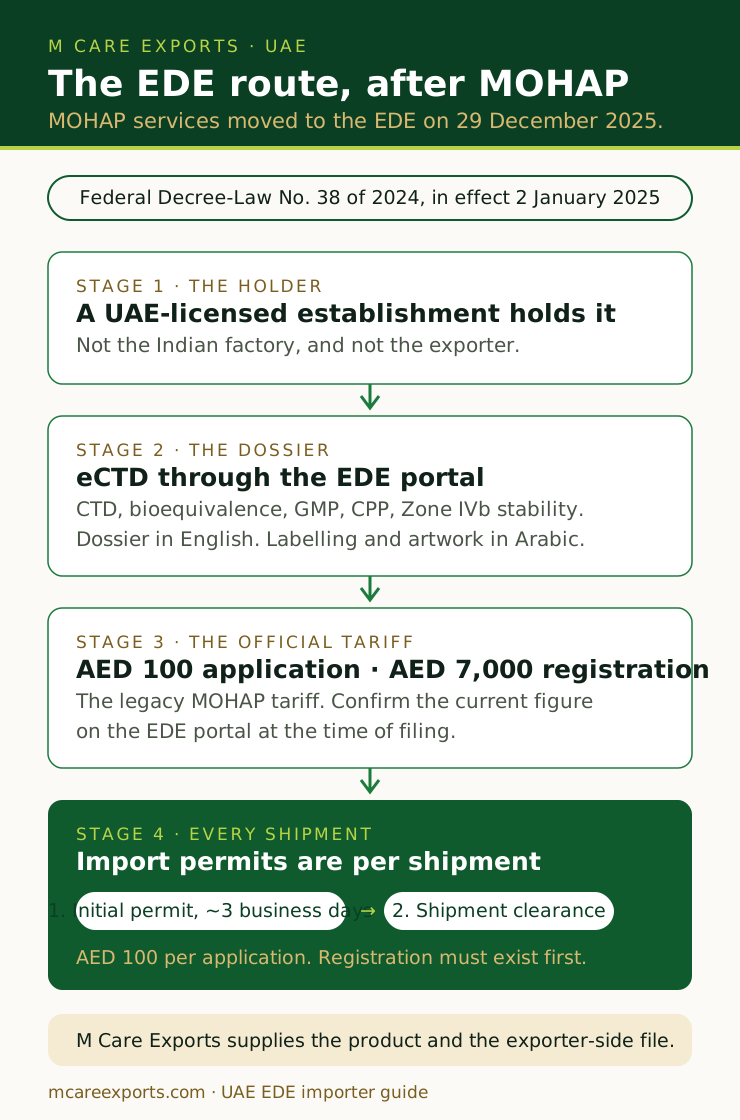
Who holds the registration, and why you now need more than one importer.
The registration never sits with the Indian side. A UAE-based authorised agent, which must be a licensed pharmaceutical establishment (typically a medical warehouse or marketing office), submits the marketing-authorisation application via the EDE portal and manages post-market obligations such as regulatory affairs and pharmacovigilance on the manufacturer's behalf. Foreign companies cannot hold UAE pharmaceutical facility licences or import permits, so every consignment must also be imported by a UAE-licensed establishment authorised on the product's registration.
There is a structural change here that many buyers have not yet priced in. Article 22 of Federal Decree-Law No. 38 of 2024 requires the marketing authorisation holder to appoint at least two licensed importers and one or more distributors for each product. This carries forward a requirement first introduced by Federal Decree-Law No. 11 of 2023. Advisory guidance additionally indicates that one designated pharmaceutical establishment should be nominated as responsible for regulatory affairs, pharmacovigilance and quality management across the product lifecycle; confirm that designation requirement with the EDE or your agent, as the detailed conditions await executive regulations.
On 24 February 2026 the EDE announced the activation of a mechanism, described in its own announcement as a first of its kind, obliging pharmaceutical companies to appoint more than one authorised agent for each medical product marketed in the UAE. The EDE framed the move as breaking single-exclusive-distributor monopolies and strengthening pharmaceutical security, with Director General Dr. Fatima Al Kaabi stating it will help regulate medical product distribution and improve supply-management efficiency.
Two honest caveats. First, as of early July 2026 no published transition timeline, product-category carve-outs or penalty schedule for existing exclusive-agent arrangements has been located, so if you currently sit inside an exclusive arrangement, confirm your position with the EDE or UAE counsel. Second, the mechanism is designed to allow additional agents to operate alongside an existing distributor rather than displacing the incumbent, which opens the door for new entrants on already-registered products. But the exact EDE procedure for adding an agent to an existing registration has not yet been published, so that route should be scoped case by case rather than assumed.
What goes into the dossier: CTD, bioequivalence, GMP, CPP and Zone IVb stability.
The dossier follows the ICH Common Technical Document structure, submitted electronically (eCTD) through the EDE digital portal, with your local agent logging in via UAE PASS. The technical dossier is prepared in English; Arabic is required for product labelling and patient-facing information, and some administrative documents are submitted bilingually. Regulatory consultants consistently flag poor Arabic translations as a common cause of registration queries and delays, so professional Arabic artwork review before submission is money well spent.
For a generic, bioequivalence with the reference product must be demonstrated. BE studies conducted to internationally recognised standards (GCC, EMA or FDA guidelines) are expected, but confirm the accepted reference product and study design against current EDE and GCC guidance before commissioning anything. The product must also be confirmed as not infringing UAE intellectual-property and trademark protections.
GMP evidence is required for the manufacturing site. Under the current framework this can be a GMP certificate issued by the EDE (or previously MOHAP), or, per current regulatory guidance, a certificate from the competent authority in the country of origin or an EDE-recognised reference authority may be accepted. Indian sites should expect the possibility of a UAE GMP inspection or desk assessment regardless. Alongside that sits the Certificate of Pharmaceutical Product (CPP) issued under the WHO scheme by the country-of-origin regulator, for India typically CDSCO or the state licensing authority; advisory sources indicate a Certificate of Free Sale may be accepted in limited cases where a CPP is unavailable. Key certificates must be legalised, including attestation by the UAE Embassy in India, before submission.
Stability data is where Indian exporters most often discover a gap. The UAE falls in climatic Zone IVb (hot and very humid), so registration stability data must include long-term studies at 30°C ± 2°C / 75% RH ± 5% and accelerated studies at 40°C ± 2°C / 75% RH ± 5%, per the GCC stability guideline. If your manufacturer holds only Zone III or EU-condition data, additional Zone IVb studies will usually be needed, and that costs months. Ask this question before you shortlist a product, not after.
The dossier must also include a pharmacovigilance plan (advisory guidance indicates this is reviewed and must be acceptable before the marketing authorisation is issued), quality-control documentation and product samples. Labelling must be bilingual Arabic and English, covering the full ingredient list in international nomenclature, dosage instructions, batch and registration numbers, manufacture and expiry dates, storage conditions and health warnings, with the patient information leaflet available in Arabic. Packs must carry GS1-compliant 2D DataMatrix codes encoding GTIN, randomised serial number, expiry and batch, because nothing moves through the UAE supply chain without Tatmeen, the national track-and-trace platform that has been mandatory since December 2022 and now sits under EDE supervision by law while still operating on the same MOHAP-built processes.
Fees, timelines and validity: what is official and what is guesswork.
Here is where we owe you plain speech, because most published guides quote figures with more confidence than the record supports. On fees: under the schedule inherited from MOHAP, the application fee is AED 100 and registration of a conventional pharmaceutical product is AED 7,000. Those two figures come from the official legacy tariff. Advisory firms cite additional line items such as product analysis (around AED 3,500), the pricing certificate (around AED 500) and pharmacovigilance-plan evaluation (around AED 1,000), with all-in per-product budgets of roughly AED 10,000 to 20,000, but those additions are consultancy figures, not published tariff. Because the services transferred to the EDE in late December 2025, confirm the current official tariff on the EDE portal at the time of filing.
On timelines: there is no officially published EDE approval timeline. Consultancy estimates range from about 45 working days (the legacy MOHAP service standard) to 3 to 6 months for a complete, well-prepared dossier, and 6 to 12 months where queries, laboratory testing or pricing negotiations intervene. Our advice as the exporting side of these projects is to plan around a realistic 6 to 12 month runway from dossier submission to first import permit, and to treat any single quoted figure as indicative only.
An expedited review route exists, but probably not for you. Advisory sources describe it as covering lifesaving, critical-care, innovative or orphan products, with reviews reported in as little as around 25 days. Standard generics do not automatically qualify, so if you are importing a routine generic range, plan around the standard pathway unless the EDE confirms priority eligibility for a specific product. Similarly, US FDA or EMA approval does not by itself shortcut UAE registration of a generic. As of mid-2026 we could not verify any published EDE reliance pathway that abridges the full dossier requirement for generic finished products; the confirmed reliance elements are acceptance of GMP certification from recognised authorities and reference to international bioequivalence standards. The 2024 law does give the EDE latitude to develop reliance mechanisms, so check current guidance rather than assuming either way.
Pricing is integrated into registration: the approved public price is fixed as part of obtaining the marketing authorisation, so pricing documents belong in the dossier from the start. Once granted, a UAE product registration is valid for five years, and renewal applications should be filed at least 90 days before expiry to avoid a lapse.
Import permits, free zones and actually moving stock.
Registration gets you a marketing authorisation. It does not move a single carton. Imported medicines must already hold EDE marketing approval before an import permit is granted, and permits are issued per shipment, having become an EDE service in the December 2025 handover. Limited exceptions exist under separate EDE services, such as named-patient and personal-use import routes, but for commercial generic supply the registration comes first, full stop.
The permit process runs in two stages via the EDE portal. First, an initial import permit is filed before the goods ship, supported by the proforma or commercial invoice, with a published processing time of around 3 business days and a fee of AED 100 per application. Second, a shipment clearance request is filed once the air waybill or bill of lading exists, with a published processing time of around 2 business days. Permits are valid for 2 months from issuance, and release of the consignment remains subject to inspection at customs clearance. As with everything post-handover, treat published fees and timings as indicative and confirm on the EDE portal at the time of filing.
Free-zone routing remains a live strategy in 2026. The 2024 law defines import as bringing medical products from outside the country or its free zones into the mainland, so stock held in JAFZA or DAFZA (see the UAE market desk for how we run bonded free-zone stock) sits outside the regulated mainland market until formally imported. For imports from fenced free zones, the EDE adds specific conditions: an active marketing-office licence for the marketing authorisation holder, a valid EDE Good Storage Practice certificate, and a minimum of 12 months remaining shelf life on the goods. That last condition is worth planning around when you negotiate manufacturing lead times with the Indian side.
On duty: goods in a bonded free zone are duty-suspended until released to the mainland, the standard UAE and GCC rate is 5% of CIF value on release, and re-exports from the free zone attract no UAE duty. In practice, however, medicines registered with the UAE health authorities are generally exempt from customs duty under the applicable tariff exemptions. So for pharmaceuticals the free-zone advantage is chiefly regulatory and logistical (regional hub stock, deferred commitment to the mainland market, re-export flexibility) rather than a duty saving. Confirm duty treatment per HS code and per product registration status.
If you are weighing the UAE against a wider Gulf rollout, note that the GCC centralised registration route under the Gulf Health Council remains available alongside national EDE filing: one GCC-CTD dossier reviewed centrally, with GCC GMP inspection of the site, across the UAE, Saudi Arabia, Kuwait, Bahrain, Oman and Qatar. Central approval is not a marketing authorisation by itself; registration must still be finalised nationally in each state, including national pricing. Most sponsors treating the UAE as the priority market file nationally with the EDE and keep the GCC route for multi-country plans.
FAQ
Can you register our products with the EDE yourselves?
No, and you should be wary of any Indian exporter who says yes. Foreign companies cannot register products with the EDE directly and cannot hold UAE pharmaceutical facility licences. Registration is filed by a UAE-licensed establishment acting as the marketing authorisation holder or authorised representative, which in practice means your appointed local agent. What M Care does is supply the WHO-GMP product, the CTD dossier documentation, stability data and samples that your agent files with.
Do we still apply through MOHAP, or is it all EDE now?
It is EDE now. MOHAP transferred its drug-registration services, including product registration and import and export permits, to the Emirates Drug Establishment on 29 December 2025. The underlying MOHAP-era regulations and guidelines remain in force where they do not conflict with Federal Decree-Law No. 38 of 2024, so your existing documentation expectations largely carry over, but filings, permits and fee payments go through the EDE portal.
Who holds the marketing authorisation, us or the Indian manufacturer?
Neither the Indian manufacturer nor M Care. The marketing authorisation sits with a UAE-licensed pharmaceutical establishment, typically the medical warehouse or marketing office appointed as local agent. That establishment manages regulatory affairs and pharmacovigilance for the product, and any transfer of a marketing authorisation to a new owner requires EDE approval.
Do we really need to appoint two importers for one product?
Under Article 22 of Federal Decree-Law No. 38 of 2024, the marketing authorisation holder must appoint at least two licensed importers and one or more distributors per product, and in February 2026 the EDE activated an enforcement mechanism requiring more than one authorised agent per product. What has not been published yet is the transition timeline, penalties, or the procedure for adding agents to existing registrations, so structure new agency agreements with the two-importer rule in mind and confirm treatment of existing exclusive contracts with the EDE or UAE counsel.
Our shortlisted product is US FDA approved. Does that shortcut UAE registration?
Not on any pathway we can verify. As of mid-2026 there is no published EDE reliance route that abridges the full dossier requirement for generic finished products. What recognised-authority approval does help with is the GMP-evidence element and bioequivalence standards. The 2024 law gives the EDE room to develop reliance mechanisms, so it is worth checking current guidance at filing time, but do not build your launch plan on a shortcut that has not been published.
How long will registration take, and what should we budget?
Honestly: no official EDE timeline exists. Consultancy estimates run from about 45 working days to 3 to 6 months for a clean dossier, and 6 to 12 months when queries, lab testing or pricing negotiation intervene; we advise buyers to plan on 6 to 12 months from submission to first import permit. On cost, the inherited official tariff is AED 100 application plus AED 7,000 registration, with advisory firms citing all-in budgets of roughly AED 10,000 to 20,000 per product including analysis, pricing certificate and pharmacovigilance-plan line items. All fees are transitional after the EDE handover, so confirm the current tariff on the EDE portal before filing.
Can we hold stock in JAFZA or DAFZA while registration is under way?
Yes, free-zone stock sits outside the regulated mainland market until it is formally imported, which makes it a workable regional hub position. When you do move goods to the mainland, EDE conditions for imports from fenced free zones apply: an active marketing-office licence for the marketing authorisation holder, a valid EDE Good Storage Practice certificate, and at least 12 months remaining shelf life. Note the product still needs its EDE marketing approval before any mainland import permit is granted.
What stability data do you supply for the UAE, and will EU data do?
The UAE is climatic Zone IVb, so the registration file needs long-term stability at 30°C ± 2°C / 75% RH ± 5% and accelerated data at 40°C ± 2°C / 75% RH ± 5% per the GCC guideline. Manufacturers holding only Zone III or EU-condition data will usually need additional Zone IVb studies, which takes months. We screen for existing Zone IVb data when qualifying Indian manufacturers for Gulf projects, and we flag the gap before you commit to a product rather than after the dossier bounces.
Send the molecule list. We'll return an EDE-ready read.
Send the molecules and dose forms you want to bring into the UAE, and your appointed local agent if you have one. The Mumbai desk replies within one working day with WHO-GMP source options, the Zone IVb stability position per line, and an honest view of what files cleanly with the EDE and what needs a step first. See the UAE market page for how the lane works, the GCC central registration guide for the multi-country route, and the Saudi SFDA and NUPCO guide for the Kingdom next door.