
Pharmaceutical Exporter from India to Kuwait.
Kuwait is one of the highest per-capita pharmaceutical spenders in the GCC, anchored by a public system that runs through six regional general hospitals (Al-Sabah, Mubarak Al-Kabeer, Al-Amiri, Farwaniya, Jahra and the new Jahra Hospital) and a private sector led by Dar Al-Shifa, Al-Salam International, Royale Hayat, New Mowasat and Taiba. Imported finished dosage forms clear through Kuwait International Airport (KWI) and the Shuwaikh and Shuaiba sea ports, under the Ministry of Health Drug and Food Control Department. Our Mumbai regulatory team files directly with KDFC; our Dubai commercial desk sits on the same working week as Kuwait City and handles day-to-day coordination with Kuwaiti importers and tender desks.
Registering a finished product with KDFC.
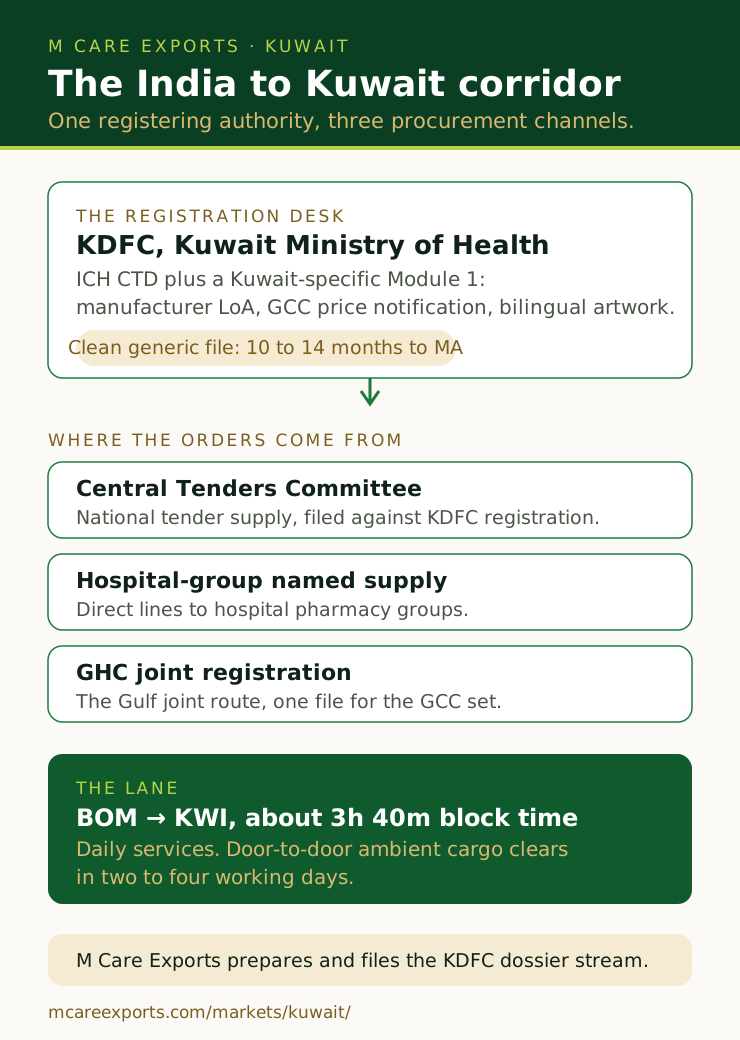
The Drug and Food Control Department (KDFC) inside the Kuwait Ministry of Health is the single authority that registers imported pharmaceuticals. Submissions follow the ICH CTD template with a Kuwait-specific Module 1 covering the letter of authorisation from the manufacturer, the GCC price notification and the proposed Arabic and English artwork. The pricing committee inside KDFC benchmarks against a basket that includes the manufacturer country, the GCC reference set and, for innovator-reference molecules, European list prices.
Timelines for a WHO-GMP sourced generic land at 10 to 14 months from first submission to marketing authorisation where the CTD is clean, the API source is pre-qualified and stability covers one year accelerated plus three months real-time. New chemical entities, biologics and complex injectables take longer. Variations (pack size, artwork, API source addition) clear faster, typically four to seven months.
Controlled substances run under the Ministry of Interior narcotic control framework in parallel with KDFC product registration. Quarterly import permits are issued against a declared quota; scheduled anaesthetics, psychiatric and pain-management lines need the importer to hold a valid narcotic licence. The Gulf Health Council joint-registration route is fully implemented in Kuwait, so a GHC authorisation covers KDFC without a separate submission cycle. Arabic labelling is mandatory: bilingual outer carton and Arabic PIL, with KDFC artwork approval before printing.
Call & WhatsApp the Mumbai desk: +91 70156 05768 · [email protected] · Mon–Sat 09:30–18:30 IST
Six capabilities, already in place.
KDFC dossier preparation and filing
In-house regulatory team drafts ICH CTD dossiers with the Kuwait-specific Module 1, handles the GCC price notification pack and coordinates variations and renewals on a shared calendar with the Kuwaiti importer of record.
Central Tenders Committee response
Full technical and commercial pack for MoH tenders routed through the CTC: KDFC registration number, CoA, CoO, GMP certificate, stability summary, PSUR, Arabic-approved artwork proof and the pricing schedule aligned to the GCC reference framework.
Private hospital group demand
Dar Al-Shifa, Al-Salam International, Royale Hayat, Taiba, New Mowasat and Hadi Clinic run Kuwait's private hospital groups, and their pharmacy desks buy directly for portfolio lines. M Care Exports quotes into that channel with batch-level traceability, CoA and CoO on every dispatch, and a QP release letter where the pharmacovigilance function requires it.
GHC joint registration
Gulf Health Council central-registration dossiers where the molecule justifies a six-state launch. We prepare the harmonised GHC pack, align artwork to GHC-wide specification and pull Kuwaiti authorisation into a single submission cycle with KSA, UAE, Oman, Qatar and Bahrain.
Arabic bilingual artwork
KDFC-compliant Arabic typesetting with native-speaker medical review, outer-carton bilingual layout, patient information leaflet translation and artwork proof secured with KDFC before any print run commits.
Controlled-substance import coordination
Quarterly quota permits countersigned by the narcotic control section, timed shipment window against the quota calendar, chain-of-custody documentation and secure airport-to-warehouse handover through a licensed Kuwaiti importer.
Mumbai to Kuwait City in under four hours of flight.
Air freight: BOM-KWI is a block time of roughly three hours and forty minutes, with Kuwait Airways, Jazeera Airways, IndiGo and Air India Express running daily services. Door-to-door for ambient pharmaceutical cargo clears in two to four working days; Kuwait Customs handles clearance through the Kuwait Customs General Administration electronic platform and our nominated freight agent manages landing-side queries. DEL-KWI and BLR-KWI back up the Mumbai gateway for north-India and south-India sourced product, and Dubai (DXB) transshipment is routinely used for consolidations under 800 kilograms where a same-week direct slot is not available.
Sea freight: Nhava Sheva (JNPT) to Shuwaikh Port and Shuaiba Port runs an eight-to-eleven-day transit, with weekly feeder sailings from MSC, CMA CGM, Hapag-Lloyd and ONE. Shuaiba handles the bulk of industrial and pharmaceutical sea cargo; Shuwaikh sits closer to the capital and takes the smaller, faster-moving containers. Less-than-container-load consolidation is available for orders below 12 CBM.
Cold-chain: Envirotainer RAP e2 and RKN e1 active containers for 2-8 degrees, va-Q-tec passive containers for 15-25 ambient, and temperature loggers on every consignment above USD 20,000 in invoice value. Kuwait International's cool-dolly capacity is reliable; the bigger risk is the tarmac window in summer when ambient hits 48 degrees, so we schedule sensitive cargo on night-arrival slots where possible. Bonded stock can be positioned at Jebel Ali (UAE) for customers who prefer a 48-hour call-off into Shuwaikh rather than holding buffer directly in Kuwait.
Payment terms: first-time customers run TT 30% advance and 70% against scanned BL, or a sight LC through a first-tier Kuwaiti bank (NBK, KFH, Gulf Bank). Repeat customers move to open account at 30, 60 or 90 days after five clean shipments, subject to credit-insurer cover from Atradius or Euler Hermes. Institute Cargo Clauses A insurance is standard, door-to-door.
What Kuwait actually orders.
Cardiometabolic is the largest single pillar. Kuwait has one of the world's highest recorded type-2 diabetes rates, with adult prevalence estimates hovering near 20%, and the cardiovascular burden tracks closely. Statins, SGLT2 inhibitors, DPP-4 inhibitors, ARBs, beta-blockers and long-acting insulin analogues flow in tender quantity through Al-Sabah, Mubarak Al-Kabeer and the Farwaniya and Jahra catchments, with supplementary private-sector volume through Dar Al-Shifa and Al-Salam.
Oncology is the second pillar and has grown steadily as the ageing cohort expands. Trastuzumab, rituximab and bevacizumab biosimilars, plus supportive-care injectables such as pegfilgrastim, granisetron and ondansetron, move through the oncology day-care units at Kuwait Cancer Control Centre and the private tertiary hospitals. Critical-care injectables (noradrenaline, vasopressin, propofol, midazolam) complete the hospital-formulary roster, along with broad-spectrum antibiotics, antifungals and the ophthalmology and dermatology lines that any high-spending market draws in.
Paediatrics and respiratory (asthma prevalence in Kuwait sits well above the regional mean) round out the steady-state volume. Every line ships with KDFC-compliant bilingual labelling and CoA-per-batch documentation.
A Kuwait City private hospital chain moved its cardiometabolic formulary under M Care Exports across H2 2024. We anchored 11 SKUs (three statins, two SGLT2 inhibitors, two DPP-4 inhibitors, two ARB fixed-dose combinations and two long-acting insulin analogues) with a 75-day forward buffer split between Jebel Ali and Shuwaikh, rewired their pharmacy-PO system to our Mumbai dispatch desk, and held the weighted landed cost 22% below the prior European-origin benchmark across 19 consignments. Pharmacy stockout incidents on the covered lines dropped from seven in the previous year to one.
Why Indian pharma, why M Care, and what a Kuwaiti buyer actually receives.
Kuwait runs a mature pharmaceutical market with relatively few, relatively large importers and an unusually price-sensitive public-tender channel sitting alongside a premium private sector. Indian manufacturing fits that shape well: WHO-GMP capacity covering roughly a fifth of global generic finished-dosage-form volume, a domestic API base that keeps off-patent molecule costs 30 to 50% below European-origin equivalents, ICH-aligned stability programmes and English-language regulatory documentation that slots into KDFC and GHC Module 1 templates without translation work.
The question most Kuwaiti procurement heads ask is not whether to source from India but which Indian house to work with. KDFC has seen its share of suppliers who disappear after the first pharmacovigilance query or the first shortage of a tender-winning line. M Care is built the other way. Our Mumbai head office is the regulatory and CMC engine: dossier writing, stability coordination, pharmacovigilance and QP release happen there, with full eCTD readiness from the first submission. Our Dubai commercial desk is the face to Kuwaiti buyers: it sits on the same working week, handles tender timing, moves bonded stock from Jebel Ali into Shuwaikh when the call-off hits, and keeps procurement heads on one phone number rather than a rotating pool.
Three specifics make the working relationship different from the usual Indian-supplier experience. First, a single named account manager who owns your file from RFQ through re-order. Second, GHC-ready dossiers: because we file through the Gulf Health Council, Kuwait can be the anchor or the follow-on of a broader GCC portfolio depending on your commercial priority. Third, honest lead times. We do not pad the quote to protect slippage, and we do not ratchet price on repeat orders. What you get is WHO-GMP-sourced product with audit-ready paperwork, consistent Arabic artwork, and a Mumbai-Dubai team that treats a Kuwaiti purchase order with the same weight as a London teaching-hospital contract.
One practical note for first-time Kuwaiti buyers: if the molecule you need is already KDFC-registered under a competing brand, a GCC-price-compliant generic from India can be a same-tender alternative rather than a fresh registration cycle. We map that route in the first call, so the quote you receive reflects the real timeline, not a theoretical one.
Kuwait pharmaceutical import: common questions.
Which authority registers pharmaceutical products in Kuwait?
The Drug and Food Control Department (KDFC) inside the Kuwait Ministry of Health. Every imported finished SKU carries a KDFC registration number. Dossiers follow ICH CTD with a Kuwait-specific Module 1, and a GCC price notification forms part of the pricing-committee review.
How long does KDFC registration typically take?
Ten to fourteen months for a WHO-GMP-sourced generic with a clean dossier, API DMF and stability covering one year accelerated plus three months real-time. New chemical entities and biologics run 16 to 22 months. GHC joint registration, where eligible, lands inside a similar window but covers all six GCC states.
Is Arabic labelling mandatory?
Yes, for outer carton (bilingual Arabic and English) and for patient information leaflet (full Arabic). KDFC prescribes minimum type height and layout conventions. We commission the Arabic typesetting, run it past a native-speaker medical reviewer, and secure KDFC artwork approval before any print run commits.
How do Central Tenders Committee submissions work?
The Ministry of Health writes the specifications, the CTC runs the public tender process and the award, and successful bidders supply against framework contracts with quarterly call-offs. The technical pack needs KDFC registration, CoA, CoO, GMP, PSUR, stability summary, Arabic-approved artwork and a price schedule aligned to the GCC reference framework. We prepare the full pack and coordinate submission through the Kuwaiti importer of record.
Do you supply controlled substances into Kuwait?
Yes, against quarterly import-quota permits issued by the Ministry of Interior narcotic control section in coordination with KDFC. Scheduled anaesthetics, pain-management and psychiatric lines require the importer to hold a valid narcotic licence. We prepare the chain-of-custody pack and time the shipment window against the quota calendar.
What cold-chain assurance do you offer on BOM-KWI shipments?
Validated Envirotainer RAP e2 or RKN e1 for 2-8 degrees active, va-Q-tec passive for 15-25 ambient, continuous temperature logging, airport-to-airport transit inside roughly four hours of flight, and a landing-side cool-dolly handover at KWI. Night-arrival slots are preferred in peak summer. Insurance on Institute Cargo Clauses A, door-to-door.
How is payment typically structured with Kuwaiti importers?
First-time: TT 30% advance, 70% against scanned Bill of Lading, or a sight LC through NBK, KFH or Gulf Bank. Repeat customers, post five clean shipments, move to open account at 30 to 90 days depending on volume and credit-insurer line. We work with Atradius and Euler Hermes for credit cover on larger accounts.
Why buyers choose M Care for the India → Kuwait corridor.
Kuwait MoH DPC fluency
Dossiers built to the exact format Kuwait MoH DPC reviews, not a generic CTD dump. We know which modules get scrutinised first, which stability data triggers queries, and which legalisation and apostille chain the submission needs to clear on the first pass.
Logistics you can schedule around
BOM → KWI direct air for time-critical orders, and Shuwaikh for high-volume ambient sea freight. Cold-chain SKUs run on validated containers with continuous temperature logging. Consolidation at origin so you order by molecule, not by MOQ.
Commercial discipline, one point of contact
USD invoicing with clear FX-clause language, LC / TT / open-account progression as the relationship proves out, 18 therapeutic areas on one PO, and one named account manager from enquiry through clearance in Kuwait.
Top categories we ship to Kuwait
Cardiovascular
Antihypertensives, statins, anticoagulants, antiarrhythmics and heart-failure lines.
Diabetes & endocrine
Insulins, oral antidiabetics, thyroid and hormonal therapy, 470+ lines across the spectrum.
CNS & neurology
Antiepileptics, antipsychotics, antidepressants, anxiolytics and neuroprotective lines.
General & OTC
Analgesics, vitamins, wound-care, nutritionals, 1,283 SKUs, our broadest catalogue.
Services that fit Kuwait procurement workflows.
GCC central registration
GCC central registration via Kuwait MOH DFC with mutual recognition across UAE, KSA, Qatar, Bahrain and Oman.
GCC tender response
CMSPS (Central Medical Stores and Pharmaceutical Services) tender mechanics for Al-Sabah, Mubarak, Amiri and Adan hospital network.
MoH product registration, GCC
Kuwait MOH DFC product registration and three-buyer-type framework (public tender, private chains, named-patient).
WHO-GMP compliance
WHO-GMP CoPP and Site Master File for Kuwait Cancer Control Center haematology and CMSPS prequalification.
Cold-chain validation
Kuwait International Airport (KWI) inbound via Kuwait Airways Cargo, qualified shipper temperature logs, MOH cold-store handover.
Sourcing generics across the Gulf.
Kuwait drug registration and import from India.
How Kuwait's Ministry of Health registers medicines, licenses local agents, and links to GCC central registration for pharmaceutical imports from India.
GCC central drug registration, explained.
The pan-Gulf registration route (GCC-DR) and how one dossier can open multiple Gulf states alongside the national filings.
NUPCO bid mechanics for an Indian WHO-GMP supplier.
How Gulf government tenders are structured, and what a supplier and product need to be eligible to bid.
Unlicensed medicines for GCC hospitals.
How named-patient and unlicensed-import routes work for Gulf hospital pharmacies when no registered product exists.
More Gulf and Middle East desks: Saudi Arabia · UAE · Qatar · Oman · Bahrain · Iraq
Molecule, volume, target buyer. One working day to a quote.
Your enquiry goes directly to the account manager responsible for Kuwait. No call-centre hops, no generic autoresponders, just the answer your procurement file needs.
Start a Kuwait enquiry → Back to all marketsBuying for repeat supply? Open a trade account for a named account manager and priced quotes.